Chapter 4 — Trigonometry
Part 1: Right-Angled Triangle Trigonometry (SOHCAHTOA)
1.1 The Ratios
For a right-angled triangle with angle θ:
- $\sin \theta = Opposite / Hypotenuse$
- $\cos \theta = Adjacent / Hypotenuse$
- $\tan \theta = Opposite / Adjacent$
Memory aid: SOH CAH TOA

Пояснение: Тригонометрические отношения SOH CAH TOA
SOH CAH TOA — это фундамент всей тригонометрии. Эти три отношения работают ТОЛЬКО в прямоугольных треугольниках. Для любых других треугольников понадобятся синусная и косинусная теоремы (Parts 2-3). Запомни аббревиатуру — она помогает не перепутать формулы на экзамене.
1.2 Finding a Side
Example (ISMA Prep Q3): Triangle ABC, angle B = 90°, angle C = 65°, BC = 8.4 cm. Find AB.
$\displaystyle \tan 65^{\circ} = \frac{AB}{BC} = \frac{AB}{8.4}$
$AB = 8.4 \times \tan 65^{\circ} = 8.4 \times 2.145 = 18.0 cm (3 s.f.)$
Пояснение: Нахождение стороны
Это базовый тип задачи SOHCAHTOA: дан угол и одна сторона — найди другую. Главное — правильно определить, какие стороны являются Opposite, Adjacent и Hypotenuse относительно данного угла, и выбрать нужную формулу (sin, cos или tan). Такие задачи есть почти в каждом экзамене.
1.3 Finding an Angle
Use inverse functions: $\theta = \sin^{-1}(x), \cos^{-1}(x), \tan^{-1}(x)$
Пояснение: Нахождение угла
Обратные функции (sin⁻¹, cos⁻¹, tan⁻¹) — это кнопки на калькуляторе, которые дают угол по известному отношению сторон. Сначала найди отношение (например, O/H), потом нажми sin⁻¹. На экзаменационном калькуляторе они на вкладке Func.
1.4 Exact Trigonometric Values (Know These — Saves Time Even With a Calculator)
| Angle | $\sin$ | $\cos$ | $\tan$ |
|---|---|---|---|
| 0° | 0 | 1 | 0 |
| $\displaystyle 30^{\circ} \frac{\pi}{6}$ | $\displaystyle \frac{1}{2}$ | $\displaystyle \frac{\sqrt{3}}{2}$ | $\displaystyle \frac{1}{\sqrt{3}}$ |
| $\displaystyle 45^{\circ} \frac{\pi}{4}$ | $\displaystyle \frac{\sqrt{2}}{2}$ | $\displaystyle \frac{\sqrt{2}}{2}$ | 1 |
| $\displaystyle 60^{\circ} \frac{\pi}{3}$ | $\displaystyle \frac{\sqrt{3}}{2}$ | $\displaystyle \frac{1}{2}$ | $\sqrt{3}$ |
| $\displaystyle 90^{\circ} \frac{\pi}{2}$ | 1 | 0 | undefined |
Пояснение: Точные значения тригонометрических функций
Хотя на экзамене есть калькулятор, знание точных значений для 30°, 45°, 60° экономит время и позволяет проверять ответы. Если в задаче получается sin 30° = 0.5 или cos 60° = 0.5, ты сразу видишь, что на правильном пути. Также полезно для упрощения выражений без калькулятора.
Part 2: The Sine Rule
2.1 The Rule
For any triangle with sides a, b, c opposite angles A, B, C:
$\displaystyle \frac{a}{\sin A} = \frac{b}{\sin B} = \frac{c}{\sin C}$
Use when you have: an angle and its opposite side, plus one more piece of information.

Пояснение: Синусная теорема
Синусная теорема связывает стороны и противолежащие углы: a/sin A = b/sin B = c/sin C. Используй её, когда есть хотя бы одна пара «сторона + противолежащий угол» (AAS или ASA). Это одна из двух ключевых формул для произвольных треугольников — вторая это косинусная теорема (Part 3).
2.2 The Ambiguous Case
When using the sine rule to find an angle, there may be two possible answers (since sin θ = sin(180° − θ)).
Пояснение: Неоднозначный случай синусной теоремы
Это одна из главных ловушек на экзамене: sin θ = sin(180° − θ), поэтому при нахождении угла через синусную теорему всегда получается ДВА возможных ответа. Нужно проверить оба и отбросить тот, при котором сумма углов треугольника превышает 180°. Экзаменаторы специально включают такие задачи.
Part 3: The Cosine Rule
3.1 Finding a Side
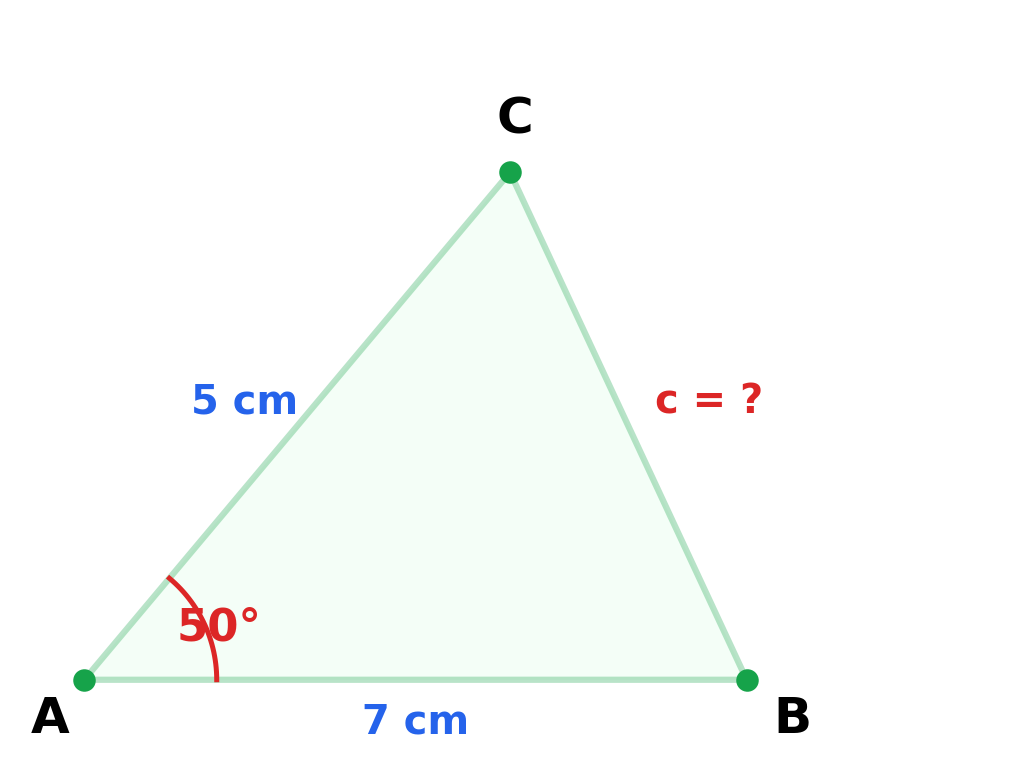
$a^{2} = b^{2} + c^{2} - 2bc \cos A$
Use when you have: two sides and the included angle (SAS).
Пояснение: Нахождение стороны через косинусную теорему
Косинусная теорема — это обобщение теоремы Пифагора для любого треугольника (не только прямоугольного). Используй её, когда даны две стороны и угол МЕЖДУ ними (SAS). Если угол 90°, формула упрощается до обычного Пифагора, потому что cos 90° = 0.
3.2 Finding an Angle
$\displaystyle \cos A = \frac{b^{2} + c^{2} - a^{2}}{2bc}$
Use when you have: all three sides (SSS).
Example (IB 2007): Triangle with sides ratio 2:3:4. Find cosine of largest angle.
Let sides = 2k, 3k, 4k. Largest angle is opposite largest side (4k).
$\displaystyle \cos A = \frac{4k^{2} + 9k^{2} - 16k^{2}}{2 \times 2k \times 3k} = \frac{-3k^{2}}{12k^{2}} = \frac{-1}{4}$
Пояснение: Нахождение угла через косинусную теорему
Когда даны все три стороны (SSS), единственный способ найти угол — перевёрнутая формула косинусов: cos A = (b² + c² − a²)/(2bc). Обрати внимание: если cos A отрицательный, угол тупой (больше 90°). Задача с пропорцией сторон (2:3:4) — классика экзаменов IB Latvia.
Part 4: Area of a Triangle
4.1 Using Sine
$\displaystyle Area = \frac{1}{2}ab \sin C$
where a and b are two sides and C is the included angle.
Example (IB 2004, Q9): Area = 12 cm², angle ACB = 30°, AC = x+2, BC = x.
$\displaystyle \frac{1}{2}(x)(x+2) \sin 30^{\circ} = 12$
$\displaystyle \frac{1}{2}(x)(x+2)\frac{1}{2} = 12$
$x(x+2) = 48$
$x^{2} + 2x - 48 = 0$
$(x+8)(x-6) = 0$
$x = 6$
Пояснение: Площадь треугольника через синус
Формула Area = ½ab sin C — одна из самых частых на экзамене. Она нужна, когда нет высоты, но есть две стороны и угол между ними. Часто задача комбинирует эту формулу с квадратным уравнением (как в примере выше). Главное — угол C должен быть МЕЖДУ сторонами a и b.
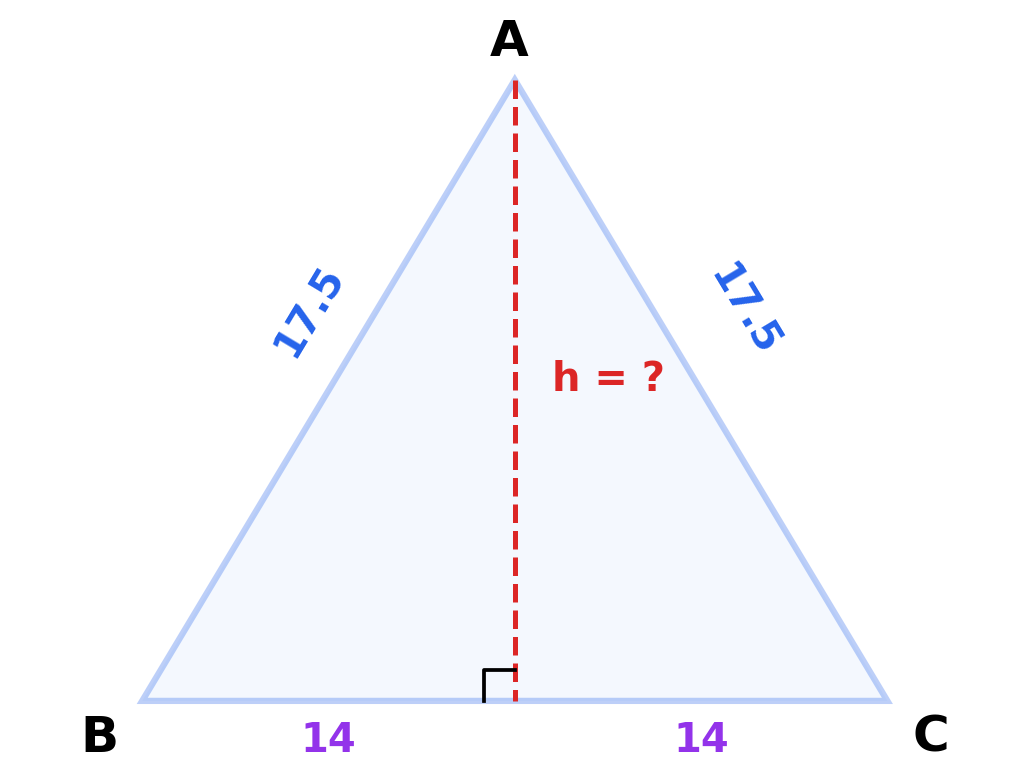
4.2 Area of Isosceles Triangle (ISMA Prep Q9)
Triangle ABC: $AB = AC = 17.5 cm, BC = 28 cm.$
Drop perpendicular from A to BC: splits base into 14 + 14.
Height h = √(17.5² − 14²) = √(306.25 − 196) = √110.25 = 10.5
Area = (1/2)(28)(10.5) = 147 cm²
Пояснение: Площадь равнобедренного треугольника
Для равнобедренного треугольника классический приём — опустить высоту на основание, которая делит его пополам. Дальше — теорема Пифагора для нахождения высоты. Это была задача Q9 из подготовительного теста ISMA — типичная для экзамена.
Part 5: Angle of Elevation and Depression
Example (Schloss Krumbach, Exe 6):
Point A is 30m from base of building B. Angle of elevation to top C = 56°, to top of flagpole D = 60°.
$BC = 30 \times \tan 56^{\circ} = 30 \times 1.48 = 44.4 m$
$BD = 30 \times \tan 60^{\circ} = 30 \times 1.73 = 51.9 m$
Flagpole CD = 51.9 − 44.4 = 7.5 m

Part 6: 3D Trigonometry and Pythagoras
6.1 Pythagoras in 3D
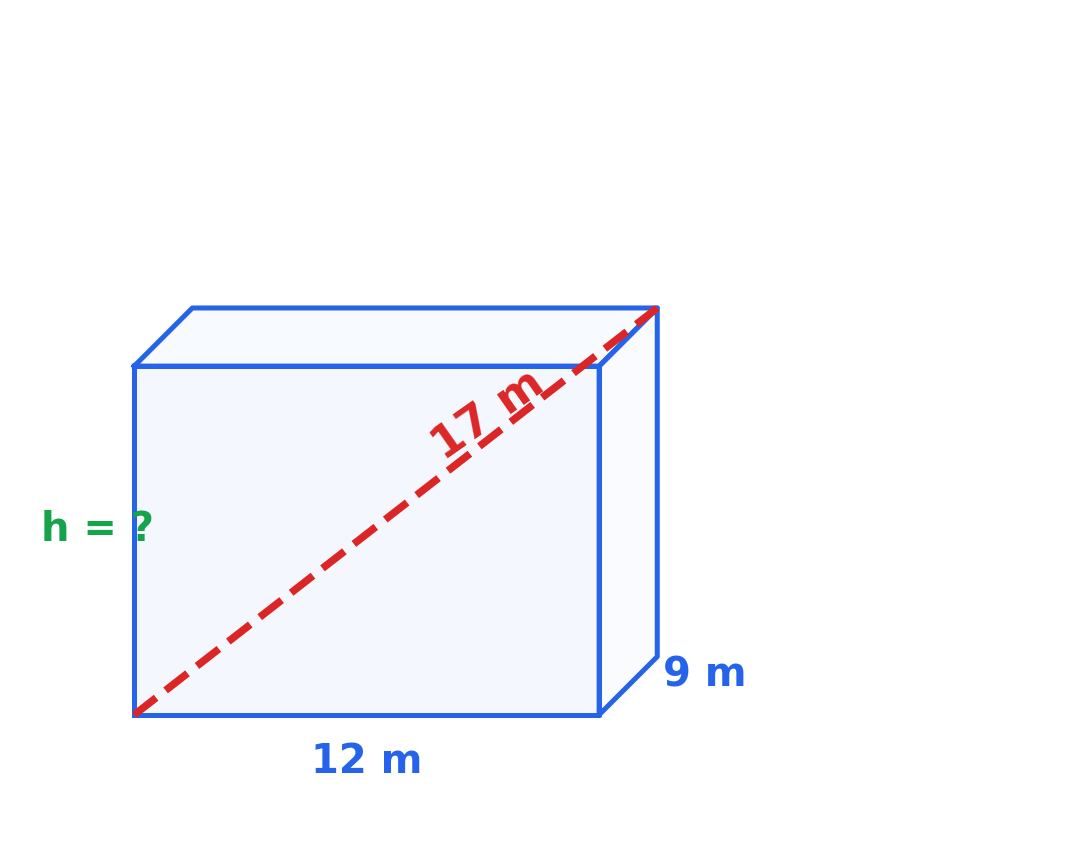
For a cuboid with dimensions l, w, h:
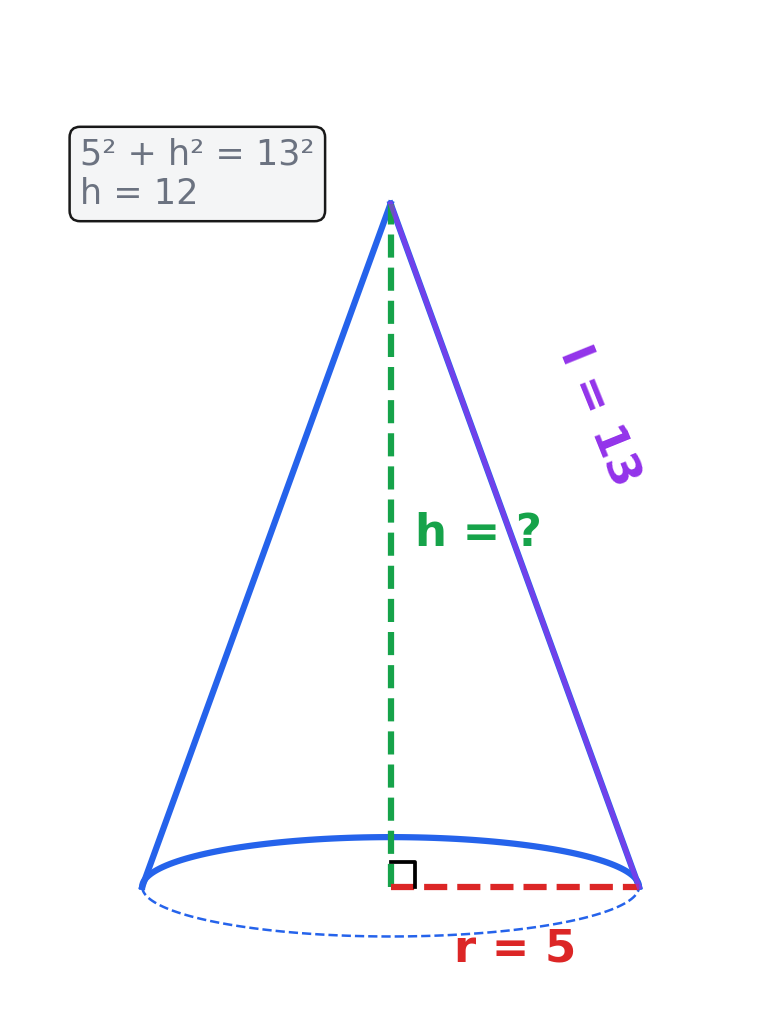
Space diagonal = √(l² + w² + h²)

Example (IB 2013, Q1): Room floor 12m × 9m, diagonal BH = 17m.
$BH^{2} = 12^{2} + 9^{2} + h^{2}$
$289 = 144 + 81 + h^{2}$
$h^{2} = 64, h = 8$
Volume = 12 × 9 × 8 = 864 m³
Пояснение: Теорема Пифагора в 3D
В 3D-задачах (комнаты, коробки, кубоиды) пространственная диагональ находится через √(l² + w² + h²) — это расширение обычной теоремы Пифагора. Такие задачи появлялись на экзаменах IB Latvia (2013). Ключ — нарисовать фигуру и найти нужный прямоугольный треугольник внутри объёмного тела.
Part 7: Circles — Arc Length and Sector Area
$\displaystyle \text{Arc length} = (\frac{\theta}{360^{\circ}}) \times 2\pi r (\text{in degrees })$
Sector area = (θ/360°) × πr² (in degrees)

Example (ISMA Prep Q16): $\text{Arc ABC} = 5 cm, \text{central angle AOC } = 55^{\circ}.$
The arc ABC subtends the 55° angle at the centre.
$\displaystyle 5 = \frac{55}{360} \times 2\pi r$
$\displaystyle r = 5 \times \frac{360}{55 \times 2\pi } = \frac{1800}{110\pi } \approx 5.21 cm$
Area of circle = π(5.21)² ≈ 85.2 cm²
Part 8: Radians and Degrees
8.1 What Is a Radian?
A radian is a way of measuring angles based on the radius of a circle.
Definition: One radian (1 rad) is the angle at the centre of a circle where the arc length equals the radius.

Since the full circumference = 2πr, a full turn contains 2π radians.
$$2\pi radians = 360^{\circ}$$
$$\pi radians = 180^{\circ}$$
Пояснение: Что такое радиан
Радианы — это альтернативная система измерения углов, которая используется в IB и высшей математике. Понимание определения (дуга = радиус → угол = 1 рад) помогает не путаться в формулах. На экзамене ISMA радианы могут появиться в задачах на дуги и секторы.
8.2 Converting Between Degrees and Radians
Degrees → Radians: multiply by π/180
$$radians = degrees \times \frac{\pi}{180}$$
Radians → Degrees: multiply by 180/π
$$degrees = radians \times \frac{180}{\pi} $$
Example 1: Convert 60° to radians.
$$60^{\circ} \times \frac{\pi}{180} = \frac{\pi}{3rad}$$
Example 2: Convert 3π/4 radians to degrees.
$$\frac{3\pi}{4} \times \frac{180}{\pi} = 135^{\circ}$$
Пояснение: Перевод между градусами и радианами
Умение быстро переводить градусы в радианы и обратно — обязательный навык. На экзамене задачи могут давать угол в одной системе, а формулы требовать другую. Запомни: градусы × π/180 = радианы, радианы × 180/π = градусы.
8.3 Key Angle Equivalents (Must Know)
| Degrees | Radians | Degrees | Radians |
|---|---|---|---|
| 0° | 0 | 180° | $\pi $ |
| 30° | $\displaystyle \frac{\pi}{6}$ | 210° | $\displaystyle \frac{7\pi}{6}$ |
| 45° | $\displaystyle \frac{\pi}{4}$ | 270° | $\displaystyle \frac{3\pi}{2}$ |
| 60° | $\displaystyle \frac{\pi}{3}$ | 300° | $\displaystyle \frac{5\pi}{3}$ |
| 90° | $\displaystyle \frac{\pi}{2}$ | 360° | $2\pi $ |
| 120° | $\displaystyle \frac{2\pi}{3}$ | ||
| 150° | $\displaystyle \frac{5\pi}{6}$ |
Pattern: divide 180 by the denominator to get the degree value.
- $\displaystyle \frac{\pi}{6} \rightarrow \frac{180}{6} = 30^{\circ}$
- $\displaystyle \frac{\pi}{4} \rightarrow \frac{180}{4} = 45^{\circ}$
- $\displaystyle \frac{\pi}{3} \rightarrow \frac{180}{3} = 60^{\circ}$
Пояснение: Ключевые углы в радианах
Эту таблицу стоит выучить — на экзамене углы часто даны в радианах (π/6, π/4, π/3 и т.д.), и если ты не узнаёшь их сразу, потеряешь время на перевод. Запомни правило: раздели 180 на знаменатель — получишь градусы.
8.4 Arc Length and Sector Area in Radians
When the angle is in radians, the formulas are simpler (no 360° denominator):
$$\text{Arc length:} \qquad s = r\theta $$
$$\text{Sector area:} \qquad A = \frac{1}{2}r^{2}\theta $$
Compare with the degree versions:
- Degrees: $\displaystyle s = (\frac{\theta}{360^{\circ}}) \times 2\pi r$
- Radians: $s = r\theta $
Example 3: A sector has radius 10 cm and angle π/3 radians. Find the arc length and area.
$$s = r\theta = 10 \times \frac{\pi}{3} = \frac{10\pi}{3} \approx 10.5 cm$$
$$A = \frac{1}{2}r^{2}\theta = \frac{1}{2}(100)\frac{\pi}{3} = \frac{50\pi}{3} \approx 52.4 cm^{2}$$
Example 4: An arc of length 15 cm belongs to a circle of radius 6 cm. Find the central angle in radians and degrees.
$$\theta = \frac{s}{r} = \frac{15}{6} = 2.5 rad$$
$$\text{In degrees:}\ 2.5 \times \frac{180}{\pi} \approx 143.2^{\circ}$$
Пояснение: Длина дуги и площадь сектора в радианах
Формулы в радианах (s = rθ и A = ½r²θ) намного проще, чем в градусах — нет дроби с 360°. На экзамене, если угол дан в радианах, используй именно эти формулы — быстрее и меньше шансов ошибиться. Если угол дан в градусах, либо переведи в радианы, либо используй формулы с 360°.
Exam Traps / Ловушки на экзамене
❌ Trap 1: Calculator in radians mode
$\sin 30^{\circ} = -0.988... — \text{clearly wrong }!$
✅ Before ANY trig calculation, check your calculator is in DEGREES mode.
Ловушка: ВСЕГДА проверяй, что калькулятор в режиме DEG (градусы), а не RAD (радианы). Иначе все ответы будут неправильными!
❌ Trap 2: Choosing the wrong trig ratio
AB is opposite to angle C, but writing sin C = AB/BC (using adjacent instead of hypotenuse).
✅ Label O, A, H relative to YOUR angle first. Then choose: SOH, CAH, or TOA.
Ловушка: стороны O, A, H определяй ОТНОСИТЕЛЬНО нужного угла. Подпиши все три стороны, потом выбирай формулу.
❌ Trap 3: Sine rule vs cosine rule — using the wrong one
Given SAS (two sides + included angle) → using sine rule — CAN'T! No opposite pair available.
✅ SAS or SSS → cosine rule. AAS, ASA, or "angle + opposite side" → sine rule.
Ловушка: синусная теорема — когда есть пара «сторона + противоположный угол». Косинусная — SAS или SSS.
❌ Trap 4: Area formula — using a NON-included angle
Sides a = 5, b = 7, using angle A (not between a and b). Area = ½ × 5 × 7 × sin A — WRONG!
✅ Area = ½ab sin C, where C is the angle BETWEEN sides a and b.
Ловушка: в формуле Area = ½ab sin C угол C обязан быть МЕЖДУ сторонами a и b (included angle).
❌ Trap 5: Sine rule ambiguous case — only one answer
sin B = 0.8 → B = 53.1° — but forgetting B = 180° − 53.1° = 126.9° is also valid!
✅ Always check BOTH values. Reject the one that makes the angle sum exceed 180°.
Ловушка: sin B = sin(180° − B). При поиске угла через синусную теорему проверяй ОБА варианта. Отбрось тот, где сумма углов > 180°.
❌ Trap 6: Cosine rule — wrong sign
$a^{2} = b^{2} + c^{2} + 2bc \cos A — WRONG!$
✅ a² = b² + c² − 2bc cos A — it's MINUS.
Ловушка: в теореме косинусов стоит МИНУС: a² = b² + c² − 2bc cos A.
❌ Trap 7: Elevation vs depression — mixed up
Angle of elevation is measured DOWN from horizontal — WRONG!
✅ Elevation = UP from horizontal (you look up). Depression = DOWN from horizontal (you look down). Both are measured FROM the horizontal.
Ловушка: elevation (возвышения) — вверх от горизонтали. Depression (понижения) — вниз от горизонтали.
❌ Trap 8: Arc length — using diameter instead of radius
$\displaystyle Arc = \frac{\theta}{360} \times 2\pi d — WRONG!$
✅ Arc = (θ/360) × 2πr. The formula uses RADIUS, not diameter.
Ловушка: в формулах дуги и сектора всегда РАДИУС. Если дан диаметр — сначала раздели на 2.