Chapter 12 — Miscellaneous Topics
Number Types and Number Sets
Every number you work with in MYP mathematics belongs to one or more of the standard number sets. Understanding where a number fits helps you answer classification questions on the exam.
The Number Sets
| Symbol | Name | Description | Examples |
|---|---|---|---|
| N | Natural numbers | The counting numbers | 1, 2, 3, 4, 5, ... |
| Z | Integers | Natural numbers, their negatives, and zero | $..., -3, -2, -1, 0, 1, 2, 3, ...$ |
| Q | Rational numbers | Expressible as a fraction of two integers | $7, -3, 0.5, 0.75, 0.333...$ |
| Irrational numbers | Numbers that cannot be written as a fraction of two integers | $\sqrt{2}, \sqrt{7}, \pi , e$ | |
| R | Real numbers | All rational and irrational numbers together | Every number on the number line |
Set Containment
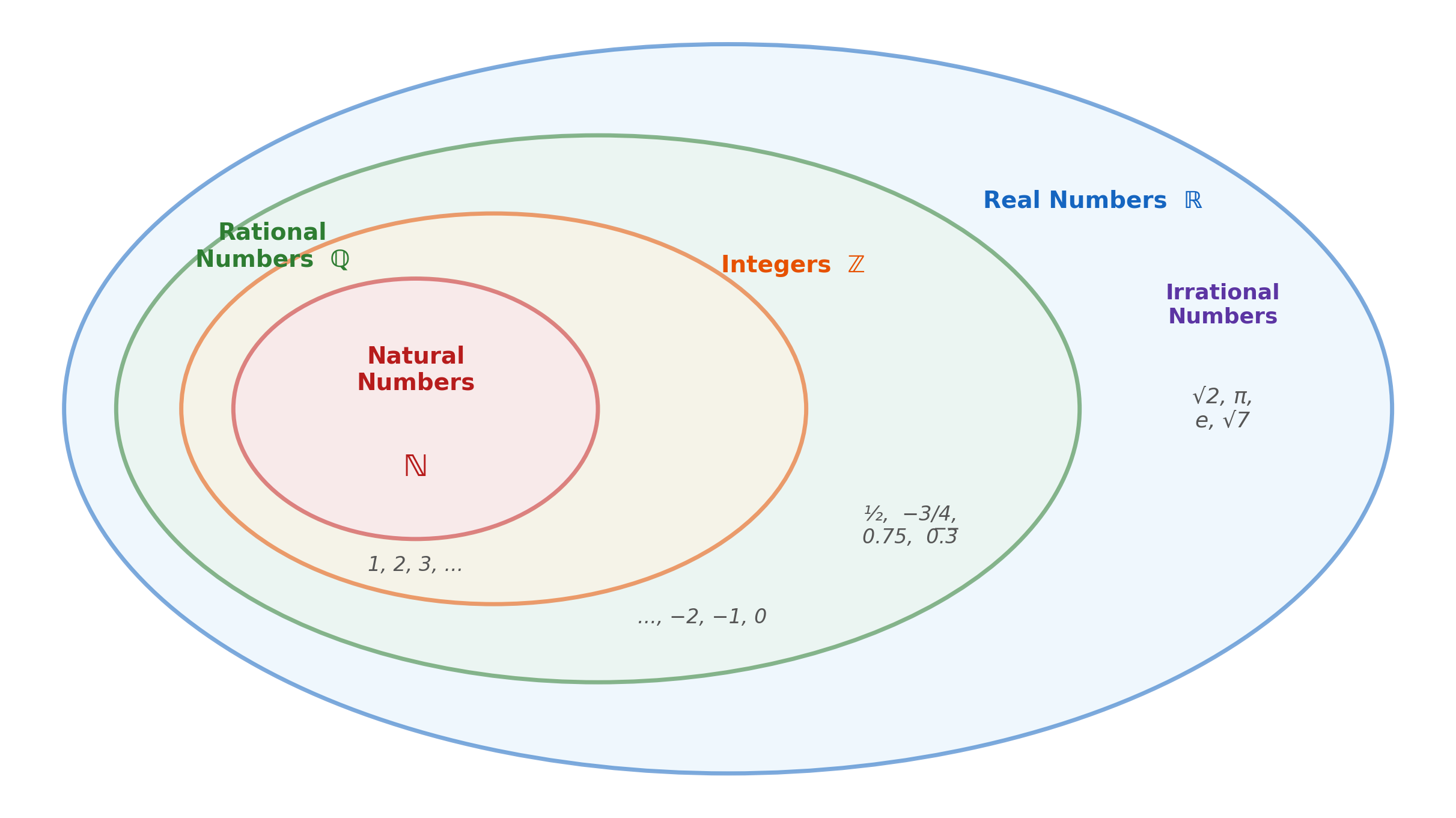
Every natural number is an integer, every integer is rational, and every rational number is real:
N ⊂ Z ⊂ Q ⊂ R
Rational Numbers — Key Facts
A number is rational if it can be expressed as a fraction of two integers (with denominator not equal to zero).
This includes:
- All integers, because every integer can be written as a fraction with denominator 1
- All fractions of integers
- All terminating decimals, because they can be converted to fractions
- All recurring (repeating) decimals, because they can also be converted to fractions
Examples of rational numbers:
$$7 = \frac{7}{1} \qquad \text{(integer written as fraction)}$$
$$-3 = \frac{-3}{1} \qquad \text{(negative integer)}$$
$$\frac{3}{4} = 0.75 \qquad (fraction = \text{terminating decimal })$$
$$\frac{1}{3} = 0.333... \qquad (fraction = \text{recurring decimal })$$
$$\frac{22}{7} \approx 3.142857142857... \qquad (fraction = \text{recurring decimal })$$
Irrational Numbers — Key Facts
Numbers that cannot be written in rational form are called irrational numbers.
- Surds such as √2 and √7 are irrational
- $\pi (\text{which is } 3.14159265...) \text{is irrational }$
- e (which is 2.71828...) is irrational
- Non-recurring, non-terminating decimals such as 0.12233344445... are irrational
The decimal expansion of an irrational number goes on forever without repeating.
How to Classify a Number
| Ask yourself | If YES → | If NO → |
|---|---|---|
| Is it a counting number (1, 2, 3, ...)? | N (and also Z, Q, R) | Keep checking |
| Is it a whole number or its negative (including zero)? | Z (and also Q, R) | Keep checking |
| Can it be written as a fraction of two integers? | Q (and also R) | It is irrational (still R) |
Example 1: Classify each number. State ALL sets it belongs to.
| Number | Sets | Reason |
|---|---|---|
| 5 | N, Z, Q, R | Natural number |
| $-3$ | Z, Q, R | Integer, not natural |
| $\displaystyle \frac{2}{3}$ | Q, R | Rational, not an integer |
| $\sqrt{9} = 3$ | N, Z, Q, R | Simplifies to a natural number |
| $\sqrt{5}$ | R only | Irrational (5 is not a perfect square) |
| 0 | Z, Q, R | Integer; by convention 0 is not in N |
| $\pi $ | R only | Irrational |
| $-0.75$ | Q, R | Rational (equals −3 over 4), not an integer |
Part 1: Radicals (Surds)
1.1 What Is a Radical?
A radical is a number written using the radical sign √. The expression √a is read as "the square root of a."
Some radicals simplify to rational numbers:
- $\sqrt{4} = 2, \sqrt{9} = 3, \sqrt{16} = 4, \sqrt{25} = 5$
These are rational because the number under the radical sign is a perfect square.
Other radicals do NOT simplify to a nice fraction or terminating decimal:
- $\sqrt{2} = 1.41421356..., \sqrt{3} = 1.73205080..., \sqrt{5} = 2.23606797...$
These are irrational — their decimal expansions go on forever without repeating. Irrational radicals are also called surds.
| Type | Examples | Why? |
|---|---|---|
| Rational radical | $\sqrt{4}, \sqrt{9}, \sqrt{25}, \sqrt{1/4}$ | Perfect squares — simplify to a fraction |
| Irrational radical (surd) | $\sqrt{2}, \sqrt{3}, \sqrt{5}, \sqrt{7}$ | Not perfect squares — infinite non-repeating decimal |
Пояснение: Что такое радикал
Радикал (корень) — это способ записи числа через знак √. Главное: если под корнем полный квадрат (4, 9, 25...), результат рациональный; если нет (2, 3, 7...) — иррациональный (сурд). На экзамене часто просят определить, рациональное число или нет — именно этот признак и нужен.
1.2 Square Roots — Definition
The square root of a (written √a) is the positive number that, when squared, gives a.
$$\sqrt{a} \times \sqrt{a} = a \qquad \text{(where a is non-negative)}$$
Key points:
- For √a to exist (in real numbers), $\text{we need } a \geq 0.$
- The square root is always non-negative: √9 = 3, not ±3.
❌ Common mistake: Writing √9 = ±3. The symbol √ always means the positive root. When solving x² = 9, we get x = ±3 — but that is because there are two solutions to the equation, not because √9 has two values.
✅ Correct: √9 = 3 (always positive). If x² = 9, then x = ±√9 = ±3.
Пояснение: Квадратный корень — определение
Квадратный корень √a — это ВСЕГДА положительное число. Частая ошибка на экзамене: написать √9 = ±3. Нет! √9 = 3. Знак ± появляется только когда решаешь уравнение x² = 9, потому что у уравнения два решения. Также помни: √a существует только при a ≥ 0 (в действительных числах).
Example 1: Evaluate each expression.
$$(a) \sqrt{49} = 7$$
$$(b) \sqrt{1/4} = \frac{1}{2}$$
$$(c) -\sqrt{25} = -5 \qquad \text{(the minus is outside the radical)}$$
Example 2: State whether each statement is true or false, and explain why.
(a) Statement: √0 = 0. This is True because 0 × 0 = 0.
(b) Statement: √(−4) = −2. This is False because the square root of a negative number is not real.
(c) Statement: (√7)² = 7. This is True by the definition of square root.
1.3 Radicals on a Number Line
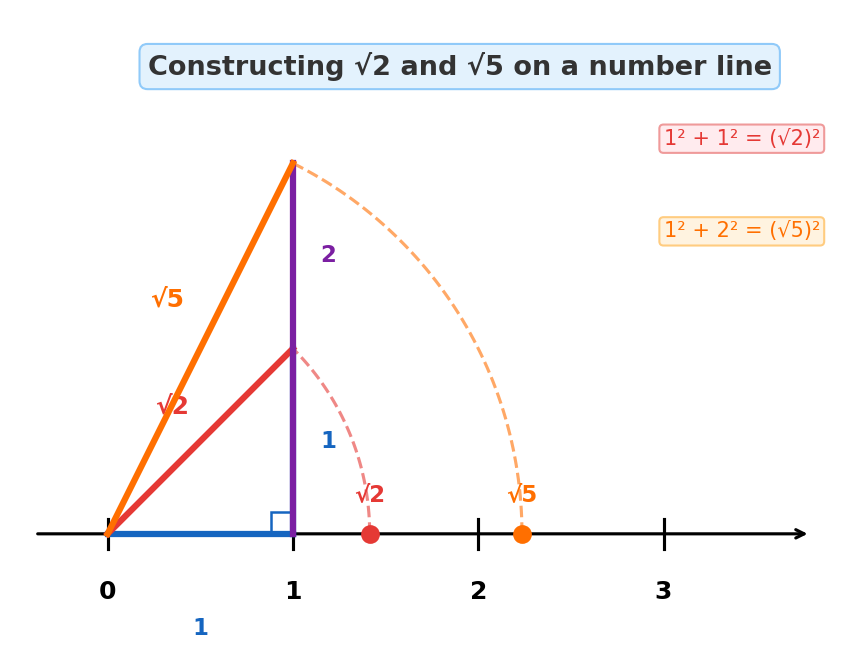
We can locate surds on a number line using Pythagoras' theorem. The idea: if we construct a right-angled triangle whose hypotenuse has length √n, we can transfer that length onto the number line.
The method:
If n = a² + b², then a right-angled triangle with legs a and b has hypotenuse √n (by Pythagoras).
| Surd | Decomposition | Triangle legs |
|---|---|---|
| $\sqrt{2}$ | $1^{2} + 1^{2} = 2$ | 1 and 1 |
| $\sqrt{5}$ | $1^{2} + 2^{2} = 5$ | 1 and 2 |
| $\sqrt{8}$ | $2^{2} + 2^{2} = 8$ | 2 and 2 |
| $\sqrt{10}$ | $1^{2} + 3^{2} = 10$ | 1 and 3 |
| $\sqrt{13}$ | $2^{2} + 3^{2} = 13$ | 2 and 3 |
$\text{Construction steps } (for \sqrt{2}):$
- Draw a number line and mark 0 and 1.
- At the point 1, draw a perpendicular of length 1 upwards.
- Connect the origin (0) to the top of the perpendicular — this line has length √(1² + 1²) = √2.
- Using a compass centred at 0 with radius √2, draw an arc that meets the number line. This point is √2.
Example 3: How would you construct √5 on a number line?
We need two numbers whose squares add to 5: $1^{2} + 2^{2} = 5.$
- From the origin, mark the point 1 on the number line.
- At the point 1, draw a perpendicular of length 2 upwards.
- The line from the origin to the top of the perpendicular has length √(1² + 2²) = √5.
- Use a compass to transfer this length onto the number line.
Example 4: Between which two consecutive integers does √7 lie?
Since 2² = 4 and 3² = 9, and 4 < 7 < 9, we have 2 < √7 < 3.
More precisely: √7 ≈ 2.646, so √7 is between 2 and 3, closer to 3.
Example 5: Between which two consecutive integers does √40 lie?
Since 6² = 36 and 7² = 49, and 36 < 40 < 49, we have 6 < √40 < 7.
Пояснение: Радикалы на числовой прямой
Этот раздел показывает, что иррациональные числа — настоящие точки на числовой прямой, а не абстракция. Метод с теоремой Пифагора (построить прямоугольный треугольник с нужной гипотенузой) иногда встречается на экзамене как задача на построение. Практический навык: уметь быстро определить, между какими целыми числами лежит √n — сравни n с ближайшими полными квадратами.
1.4 Operations with Radicals — Adding and Subtracting
We add and subtract like radicals the same way we combine like terms in algebra.
In algebra: 3x + 2x = 5x (same variable → combine coefficients).
With radicals: 3√2 + 2√2 = 5√2 (same radicand → combine coefficients).
The rule:
$$a\sqrt{n} + b\sqrt{n} = (a + b)\sqrt{n}$$
$$a\sqrt{n} - b\sqrt{n} = (a - b)\sqrt{n}$$
You can only combine radicals with the same number under the radical sign (same radicand).
❌ Common mistake: √(a + b) = √a + √b — this is WRONG! You cannot split a radical over addition or subtraction.
✅ Check: √(9 + 16) = √25 = 5, but √9 + √16 = 3 + 4 = 7. Since 5 ≠ 7, the split does not work.
Example 6: Simplify each expression.
$$(a) 3\sqrt{5} + 4\sqrt{5} = 7\sqrt{5}$$
$$(b) 5\sqrt{3} - \sqrt{3} = 4\sqrt{3}$$
$$(c) 2\sqrt{7} + 3\sqrt{7} - \sqrt{7} = 4\sqrt{7}$$
Example 7: Simplify $6\sqrt{2} - 3\sqrt{3} + 2\sqrt{2} + 5\sqrt{3}$
Group like radicals:
$$= (6\sqrt{2} + 2\sqrt{2}) + (-3\sqrt{3} + 5\sqrt{3})$$
$$= 8\sqrt{2} + 2\sqrt{3}$$
This cannot be simplified further because √2 and √3 are unlike radicals.
Example 8: Simplify $3\sqrt{5} - 2\sqrt{5} + 4\sqrt{2} - \sqrt{2}$
$$= (3\sqrt{5} - 2\sqrt{5}) + (4\sqrt{2} - \sqrt{2})$$
$$= \sqrt{5} + 3\sqrt{2}$$
Example 9: Show that $\sqrt{7 - 2} \neq \sqrt{7} - \sqrt{2}$
$$\sqrt{7 - 2} = \sqrt{5} \approx 2.236$$
$$\sqrt{7} - \sqrt{2} \approx 2.646 - 1.414 = 1.232$$
Since 2.236 ≠ 1.232, we confirm that $\sqrt{7 - 2} \neq \sqrt{7} - \sqrt{2}$
This illustrates the critical rule: you cannot distribute the radical sign over addition or subtraction.
Пояснение: Сложение и вычитание радикалов
Работает точно как с переменными: 3√2 + 2√2 = 5√2, но √2 + √3 нельзя упростить (разные «подкоренные»). Главная ловушка на экзамене: √(a + b) НЕ равно √a + √b — это проверяют почти каждый год. Проверь себя: √(9+16) = √25 = 5, а √9 + √16 = 3 + 4 = 7. Не равны!
Part 2: Linear Interpolation
When data is presented in a grouped frequency table (class intervals), we cannot find the exact median or quartiles — only estimate them. Linear interpolation gives a more precise estimate than just reading from a cumulative frequency graph.
2.1 When Do We Need Linear Interpolation?
With raw data (a list of individual values), you sort the values and pick the middle one for the median — no estimation needed.
With grouped data, the individual values are hidden inside class intervals:
| Height (cm) | Frequency |
|---|---|
| $140 \leq h < 150$ | 4 |
| $150 \leq h < 160$ | 9 |
| $160 \leq h < 170$ | 15 |
| $170 \leq h < 180$ | 8 |
| $180 \leq h < 190$ | 4 |
We know that 15 students have heights between 160 and 170 cm, but we don't know their exact heights. Linear interpolation assumes the values are evenly spread within each class interval and estimates where a specific data point falls.
Пояснение: Зачем нужна линейная интерполяция
Когда данные сгруппированы в интервалы (например, рост 150–160 см — 9 человек), мы не знаем точных значений внутри интервала. Линейная интерполяция предполагает, что значения распределены равномерно, и позволяет вычислить оценку медианы или квартилей по формуле — точнее, чем «на глаз» по графику кумулятивной частоты. На экзамене этот метод часто требуется, когда дана таблица сгруппированных данных.
2.2 The Cumulative Frequency Table
Before interpolating, we build a cumulative frequency column. This is a running total of frequencies:
| Height (cm) | Frequency | Cumulative Frequency |
|---|---|---|
| $140 \leq h < 150$ | 4 | 4 |
| $150 \leq h < 160$ | 9 | 13 |
| $160 \leq h < 170$ | 15 | 28 |
| $170 \leq h < 180$ | 8 | 36 |
| $180 \leq h < 190$ | 4 | 40 |
The total number of data values is n = 40.
Key positions:
- Median position: $\displaystyle \frac{n}{2} = 20th value$
- Lower quartile (Q1) position: $\displaystyle \frac{n}{4} = 10th value$
- Upper quartile (Q3) position: $\displaystyle \frac{3n}{4} = 30th value$
Пояснение: Кумулятивная частота
Кумулятивная (накопленная) частота — это нарастающий итог: для каждого интервала складываем все частоты от начала до этого интервала. Она нужна, чтобы понять, в каком интервале «лежит» нужное значение (медиана, квартиль). Например, если медиана — 20-е значение, ищем первый интервал, где кумулятивная частота ≥ 20.
2.3 The Linear Interpolation Formula
Once we know which class interval contains the value we need, we interpolate within it:
$$\text{Estimated value} = L + \frac{p - F}{f} \times w$$
where:
| Symbol | Meaning |
|---|---|
| L | Lower boundary of the class interval containing the target value |
| p | $\displaystyle \text{The position we are looking for } (\frac{n}{2} \text{for median }, \frac{n}{4} for Q1, \frac{3n}{4} for Q3)$ |
| F | Cumulative frequency BEFORE this class (i.e. the cumulative frequency of the previous class) |
| f | Frequency of this class (the class containing the target) |
| w | Width of this class interval |
The idea is simple: we are finding what fraction of the way through the class interval our target position falls, then converting that fraction into an actual value.
Пояснение: Формула линейной интерполяции
Формула: Значение = L + ((p − F) / f) × w. Логика проста: (p − F) — сколько значений «внутрь» интервала нам нужно пройти, f — сколько всего значений в интервале, w — ширина интервала. Получаем долю пути через интервал и переводим её в единицы измерения (см, кг и т.д.). L — нижняя граница интервала, от которой отсчитываем.
2.4 Finding the Median — Worked Example
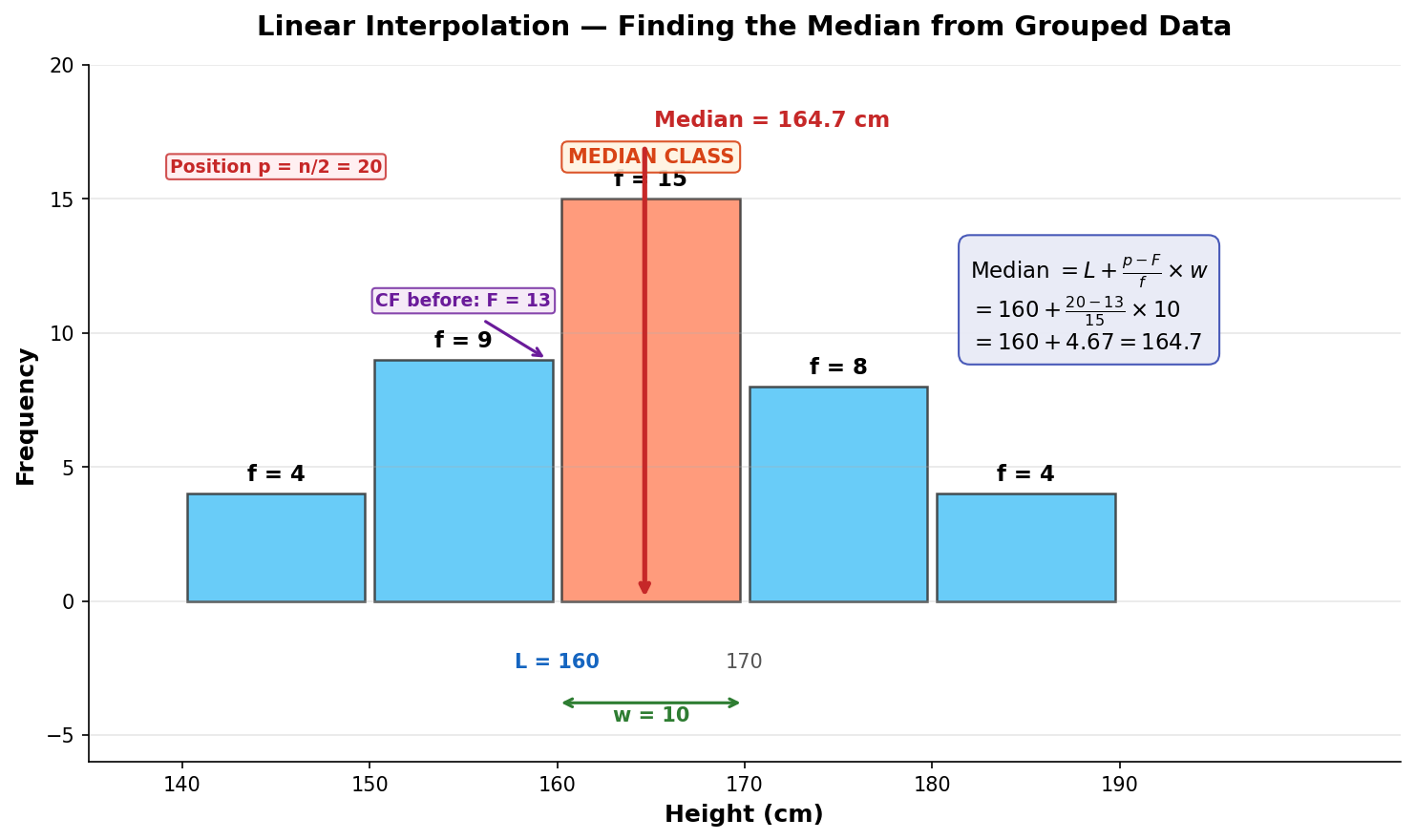
Using the height data above (n = 40):
Step 1: Find the median position.
$$\text{Median position} = \frac{n}{2} = \frac{40}{2} = 20$$
Step 2: Identify the median class — the class where the 20th value falls.
Look at the cumulative frequency column: the cumulative frequency reaches 13 after the second class (150–160) and 28 after the third class (160–170). Since 13 < 20 ≤ 28, the 20th value is in the class 160 ≤ h < 170.
Step 3: Read off the values for the formula.
L = 160 (lower boundary of median class)
$$p = 20 \qquad \text{(median position)}$$
F = 13 (cumulative frequency before the median class)
$$f = 15 \qquad \text{(frequency of the median class)}$$
$$w = 10 \qquad \text{(width: 170 - 160)}$$
Step 4: Apply the formula.
$$Median = L + \frac{p - F}{f} \times w$$
$$Median = 160 + \frac{20 - 13}{15} \times 10$$
$$Median = 160 + \frac{7}{15} \times 10$$
$$Median = 160 + 4.67$$
$$Median = 164.7 cm (1 d.p.)$$
This tells us the estimated median height is 164.7 cm.
Пояснение: Нахождение медианы
Алгоритм: (1) вычисли позицию медианы: n/2; (2) найди по кумулятивной частоте, в каком интервале лежит эта позиция; (3) подставь значения в формулу. Здесь (20 − 13) = 7 означает, что медиана — 7-е значение внутри интервала 160–170, а всего в этом интервале 15 значений. Значит, мы прошли 7/15 ≈ 47% пути через интервал шириной 10, то есть 160 + 4.67 ≈ 164.7 см.
2.5 Finding Quartiles — Worked Example
Using the same data (n = 40):
Lower Quartile (Q1):
$$Q1 position = \frac{n}{4} = 10$$
The 10th value lies in the class 150 ≤ h < 160 (cumulative frequency goes from 4 to 13 in this class).
$$L = 150, p = 10, F = 4, f = 9, w = 10$$
$$Q1 = 150 + \frac{10 - 4}{9} \times 10$$
$$Q1 = 150 + \frac{6}{9} \times 10$$
$$Q1 = 150 + 6.67$$
$$Q1 = 156.7 cm (1 d.p.)$$
Upper Quartile (Q3):
$$Q3 position = \frac{3n}{4} = 30$$
The 30th value lies in the class 170 ≤ h < 180 (cumulative frequency goes from 28 to 36 in this class).
$$L = 170, p = 30, F = 28, f = 8, w = 10$$
$$Q3 = 170 + \frac{30 - 28}{8} \times 10$$
$$Q3 = 170 + \frac{2}{8} \times 10$$
$$Q3 = 170 + 2.5$$
$$Q3 = 172.5 cm$$
Interquartile Range:
$$IQR = Q3 - Q1 = 172.5 - 156.7 = 15.8 cm$$
Пояснение: Нахождение квартилей
Квартили находятся точно так же, как медиана, только позиция другая: Q1 на позиции n/4, Q3 на позиции 3n/4. Подставляй в ту же формулу. IQR = Q3 − Q1 — показывает разброс «средних 50%» данных. На экзамене часто просят найти все три: Q1, медиану и Q3, а потом IQR.
2.6 Finding Percentiles
A percentile is a value below which a given percentage of data falls. The k-th percentile (Pₖ) is at position:
$$Pₖ position = \frac{k}{100} \times n$$
Then use the same interpolation formula.
Example: Find the 90th percentile (P₉₀) from the height data (n = 40).
$$P_{90} position = \frac{90}{100} \times 40 = 36$$
The 36th value lies in the class 170 ≤ h < 180 (cumulative frequency goes from 28 to 36). Since it is exactly at 36, it falls at the upper boundary of this class.
$$L = 170, p = 36, F = 28, f = 8, w = 10$$
$$P_{90} = 170 + \frac{36 - 28}{8} \times 10$$
$$P_{90} = 170 + \frac{8}{8} \times 10$$
$$P_{90} = 170 + 10$$
$$P_{90} = 180 cm$$
Пояснение: Процентили
Процентиль Pₖ — значение, ниже которого лежит k% данных. Позиция: (k/100) × n. Дальше — та же формула интерполяции. Часто на экзамене спрашивают P₁₀, P₂₅ (= Q1), P₅₀ (= медиана), P₇₅ (= Q3), P₉₀. Если позиция попадает точно на границу интервала — ответом будет эта граница.
2.7 Common Exam Mistakes
❌ Using the wrong cumulative frequency: F is the cumulative frequency BEFORE the target class, not of the target class itself.
❌ Confusing n/2 with (n + 1)/2: For grouped data, use n/2 (not (n + 1)/2 which is for raw data lists).
❌ Forgetting to identify the correct class interval: Always check which class the target position falls in by comparing with cumulative frequencies.
❌ Using class midpoints instead of lower boundaries: L is always the lower boundary of the interval, not the midpoint.
✅ Always set up the formula clearly with labelled values before substituting — this avoids errors and earns method marks on exams.
Пояснение: Частые ошибки
Самые частые ошибки: (1) Взять кумулятивную частоту ЭТОГО интервала вместо ПРЕДЫДУЩЕГО — F всегда «до» нужного класса. (2) Для сгруппированных данных позиция медианы = n/2, а НЕ (n+1)/2. (3) Перепутать нижнюю границу с серединой интервала. Совет: всегда выписывай L, p, F, f, w отдельно перед подстановкой — это экономит время и предотвращает ошибки.